
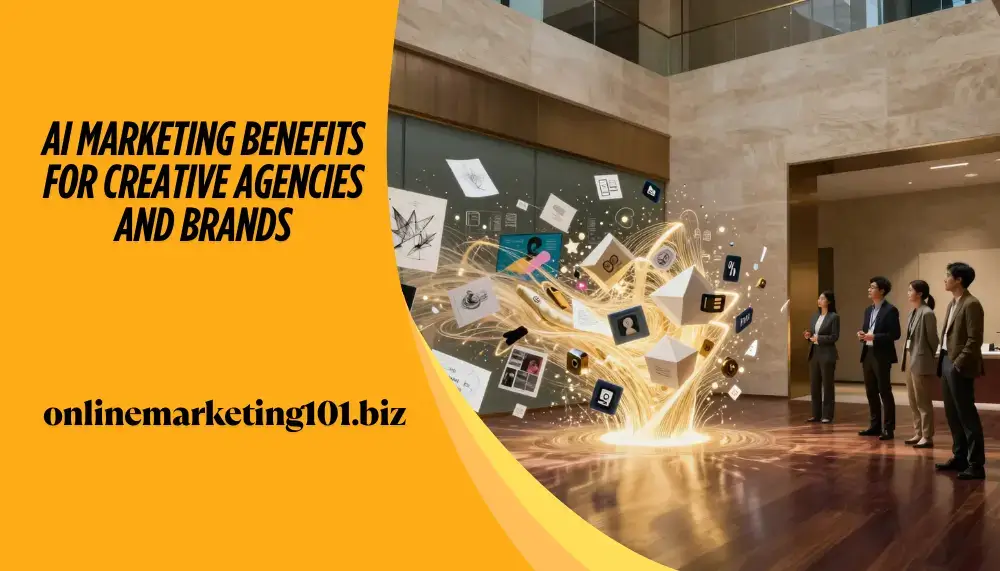
This isn’t a story about the future. AI is already the everyday tool of the best creative teams — and the brands that move now will lock in a durable competitive advantage.
3–5×Faster creative production
+38%Average campaign ROAS uplift
72%Fewer brand consistency errors
Imagine your creative team producing fifty personalised ad variations in a single working day — and always letting real data decide which one to scale. This isn’t something that happens in 2030; it’s what market-leading agencies are doing right now. The AI marketing benefits for creative teams go far beyond speed: quality, consistency and customer experience are all transformed in equal measure.
This article walks through six concrete areas where artificial intelligence is being integrated into creative workflows — and explains why the time to start is now, not after your competitors have already moved.
1. Faster brief creation: the end of wasted hours
Traditional briefing is slow and riddled with redundancy. The account manager runs the client meeting, the creative team processes the notes, and everyone ends up interpreting expectations differently. The result: misunderstandings, revision rounds, and lost days.
AI-powered brief generators rewrite this process entirely. The system draws on previous campaigns, industry benchmarks, and the key inputs from the brief to produce a structured, ready-to-use document. The creative team no longer starts from raw ideas — they start with a precise framework:
- Audience profile with demographic and psychographic data
- Automatic surfacing of competitive context and points of differentiation
- Recommendations on communication tone and creative direction
- Pre-defined KPIs and success metrics
- Platform-specific format and length recommendations
„AI doesn’t take over our strategists’ jobs — it opens up their time to actually do strategy instead of administration.”Creative Director, leading European performance agency
Brief creation time typically drops by 60–80%. More importantly, the number of client approval rounds also falls, because the document reflects expectations accurately — not based on an account manager’s memory, but on data.
2. Variation generation: breaking the creative ceiling
Creative scaling used to mean one thing: more people, more time, more money. Today it means: one strong concept + one well-crafted AI prompt = ten, fifty, even two hundred variations, ready for the team to select and refine.
This doesn’t mean AI replaces the creative strategist. Quite the opposite — the strategist becomes more valuable. Those who learn how to „train” AI on a brand’s voice can generate floods of visual and copy variations, every one of them consistent with the core strategy.
Copy variations
From a single headline, generate dozens of alternatives across different emotional registers, tones and lengths — ready for A/B testing immediately.
Visual concepts
With generative AI image creation, moodboards become real creative variations that can be presented and iterated on the same day.
Localisation
A single campaign adapted automatically for 10–15 markets — not just translated, but contextualised culturally as well.
Format adaptation
Story format, feed post, banner and email creative — all sized automatically from a single source asset.
3. AI-powered A/B testing: stop guessing, start knowing
Traditional A/B testing is static and slow. You run two variants, wait for data, then decide manually. The AI-driven approach operates on an entirely different logic.
Predictive analysis: The system draws on past campaign performance and industry patterns to predict which creative element will win — before you spend a single dollar. It isn’t perfect, but it’s statistically more reliable than gut instinct.
Real-time multivariate testing: AI can simultaneously test dozens of variables — headline, image, CTA, colour, layout — and automatically allocates budget toward the winning combination. This is the Multi-Armed Bandit algorithm, and it’s quietly revolutionising conversion optimisation.
Data ingestion and learning phase
The AI system processes historical campaign performance, audience behavioural patterns and competitive environment data.
Predictive scoring
The system ranks uploaded creative variations by expected performance, surfacing likely winners before launch.
Real-time optimisation
While the campaign runs, the algorithm continuously reallocates budget toward better-performing variants.
Learning and feedback loop
Campaign results feed back into the system as new training data, increasing the prediction accuracy of every future campaign.
4. Maintaining brand consistency at scale
As content volume grows, maintaining brand consistency becomes exponentially harder. A 20-person creative team producing content for ten clients simultaneously will make human errors. AI doesn’t get tired, doesn’t forget, and doesn’t misread the brand guidelines.
Modern AI brand compliance engines can:
- Automatically check every uploaded creative against the visual identity
- Flag tone-of-voice deviations in written content
- Filter out phrasing that poses legal or compliance risks
- Suggest real-time corrections
- Handle version control and approval workflows in an integrated way
Why does this matter for revenue?
According to Lucidpress research, consistently presented brands generate an average of 33% higher revenue. Inconsistent brand use isn’t just an aesthetic problem — it creates a trust deficit that translates directly into lost customers.
If AI catches just 10 creative errors per week that would have previously made it to market, that represents the preservation of brand equity over time — something far more valuable than any single campaign.
5. Improving campaign performance: the numbers don’t lie
The AI marketing benefits on the creative side are compelling precisely because they’re measurable. These aren’t abstract promises: performance data consistently shows that AI-assisted campaigns significantly outperform manually optimised ones.
Which tactics is AI reliably executing today? Dynamic Creative Optimisation (DCO)
DCO combines creative elements (images, headlines, CTAs) in real time based on user data: location, device type, behavioural history, remarketing status. A DCO campaign can run 200+ unique versions simultaneously, always showing the most relevant variant to each individual user.
Typical result: +25–40% CTR improvement over static creatives, particularly strong in e-commerce and travel verticals.Predictive budget allocation
Instead of manually splitting budget across channels and audiences, AI predicts where the highest return will come from over the next 7–14 days and automatically directs spend accordingly.
Meta Advantage+ and Google Performance Max already operate on this logic — any advertiser not using it is quite literally leaving money on the table.Semantic content optimisation for SEO
AI-powered SEO tools use deep search intent analysis to identify semantic gaps that competitors aren’t covering. Content can be optimised not just for individual keywords but for entire topic clusters — making this one of the most powerful organic growth levers in AI marketing.
A well-built AI-driven content strategy produces sustained organic traffic growth within 6–12 months, completely independent of advertising budgets.Churn prediction and retention marketing
AI reads behavioural signals — declining purchase frequency, falling engagement, customer service contacts — to predict which customers are approaching churn. The creative team can then launch targeted, proactive retention campaigns for those segments before the customer has even considered switching.
6. Elevating customer experience: the personalisation era has arrived
Consumers today don’t just expect personalisation — they assume it as a default. McKinsey’s 2024 data shows that 71% of customers expect personalised communications, and 76% are frustrated when they don’t receive them. AI makes it possible for mid-sized brands and agencies — not just tech giants — to operate at this level.
Creative customer experience improvements AI enables right now:
- Hyper-personalised email campaigns: not just „Dear [First Name]”, but dynamically personalised product recommendations, send times and subject lines
- Conversational AI and chatbots: 24/7 customer service with a human voice, capable of selling, supporting and winning back customers simultaneously
- Predictive content recommendations: from webshops to content platforms, AI always surfaces the next most relevant step for each user
- AI-powered customer journey mapping: mapping and optimising the full customer journey from first touchpoint to repeat purchase
„Great creative work has always been defined by saying exactly the right thing to exactly the right person at exactly the right moment. AI doesn’t do this once — it does it at every moment, at scale.”Marketing Strategist, leading digital agency
Improving customer experience isn’t just a brand-building exercise. Accenture research consistently shows that superior customer experience generates 4–8% higher revenue compared to the industry average. Investment in AI-driven personalisation pays off in both the short and long term.
Why now — and why with a creative focus?
The AI marketing benefits on the creative side reinforce each other. Faster brief creation enables better variations. More variations enable higher-quality A/B testing. Better test data drives more precise campaign optimisation. And systematically optimised campaigns deliver elevated customer experiences — which materialise as repeat purchases and brand loyalty.
The whole system only works if the creative team is an active driver of AI transformation, not a passive bystander. Agencies that learn how to integrate artificial intelligence from brief to campaign close will find themselves in a structurally stronger position — one that late movers, in „we’ll get around to it” mode, will struggle to close.
The competitive edge doesn’t come from technology — everyone has access to the same tools. It comes from people: whether your team can turn AI into genuine strategic capital.
Ready for AI-powered creative transformation?
CRS AI Marketing & SEO Agency supports you from strategy to implementation — data-driven, with a creative focus.