
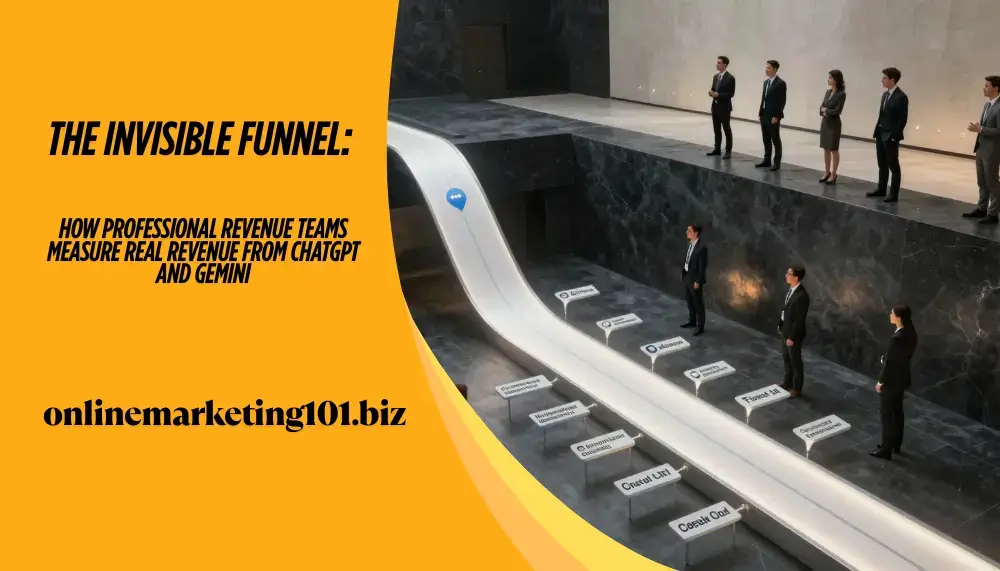
The buyer had already made a decision before they first landed on your website.
They asked ChatGPT, “Who is the best [category] provider in Hungary?”, received three names, and you were either on that list or you were not. If you were there, they may even have clicked a link, opened your website, and purchased a few days later. Except Google Analytics recorded this as “Direct” traffic, and in the monthly marketing report, exactly as much appears about it as an empty cell can hold: nothing.
This is called the dark funnel — the dark sales funnel. And in 2026, this is no longer a negligible slice. Traffic from AI search has grown by more than 500% in a single year, and in B2B, nearly 40% of the total pipeline comes from sources that traditional analytics simply cannot see. If you proudly present a dashboard to management every month, there is a good chance you have no idea about more than one third of the demand that is actually driving revenue.
The good news: the blind spot is measurable. Professional revenue teams are no longer guessing — they have built a system around it.
Why is Google Analytics blind to AI traffic?
Classic analytics was designed for one thing: the click. Someone searches, clicks, arrives, and the system neatly records the source. AI search breaks this logic in three ways.
First: many AI clicks arrive without referrer data. A significant share of visits from free ChatGPT users, mobile versions, and Gemini answers simply land as “Direct” traffic — in the same bucket as bookmarks and manually typed URLs. The revenue arrived, but there is no label on it.
Second: even when the source is passed along, it often gets lost inside a referral traffic list with hundreds of rows. chatgpt.com is there, but buried three pages deep between two webshops and a newsletter provider.
Third — and this is the most uncomfortable part: zero-click answers. When ChatGPT or Google AI Mode answers the question and the buyer does not click on you, but remembers your brand — that generates zero traffic in the report, while this was exactly what shaped the buying decision.
The result is a paradox: the better you perform in AI search, the larger your “Direct” and “Organic” traffic becomes, and the less you understand why.
What changed in May 2026?
Here comes the turning point. On May 13, 2026, Google introduced the dedicated AI Assistant channel in GA4. From that point on, recognized AI assistant visits — ChatGPT, Gemini, Claude, Copilot, and others — are placed into their own separate row instead of being mixed into referral noise. SEO teams that had been manually updating regex tables for years closed their spreadsheets with audible relief.
Except this is not a miracle cure. The new channel is not retroactive — it does not rewrite data from the months before the update, and it still does not capture zero-click interactions or traffic arriving without referrer data. In other words, the built-in channel alone only shows the tip of the iceberg. To attribute the part below the surface, more is needed.
What professional revenue teams actually do
The difference is not in a single tool, but in a layered system. This is what it looks like in practice.
1. Custom GA4 channel group with regex. In addition to the built-in channel, they add their own rule that collects patterns from chatgpt.com, perplexity.ai, gemini.google.com, claude.ai, copilot.microsoft.com, and emerging platforms into a single “AI Search” channel. This makes it possible to analyze older data retroactively in Exploration reports.
2. UTM parameters on owned links. Wherever they share links themselves — Google Business Profile, newsletters, press materials — they add manual UTM tags. This is the one point where otherwise “invisible” channels can reliably receive a label.
3. Self-reported attribution on forms. A simple question is added to demo and quote request forms: “Where did you hear about us?” — and the answer options explicitly include ChatGPT, Gemini, Perplexity, and Google AI Mode. It sounds banal, yet it is one of the most reliable signals in the dark funnel. The buyer often tells you what the browser hides.
4. CRM correlation. Time passes between citation and revenue — and that time must be understood. Experience shows that citation share moves within 4–8 weeks, AI-sourced leads appear in the CRM in months 3–4, and actually closed AI-originated revenue typically lands in months 5–7. Anyone who does not know this buries a working channel too early.
5. Multiple touchpoints, deduplicated. If someone encountered your brand first in ChatGPT and then again in Gemini before buying, there is a risk of double counting. More serious models apply a correction multiplier to avoid artificially inflating the same impact across two channels.
From clicks to forints
This is where traffic measurement and revenue measurement separate. Traffic by itself is a vanity metric. The real work begins when you assign conversion events and actual revenue value to AI-originated visits, then connect this in the CRM to pipeline and closed deals.
That is when the report becomes something even finance accepts: you are no longer saying, “Our AI traffic increased,” but, “In the last quarter, X million forints in closed revenue came from buyers who first encountered us in ChatGPT or Gemini.” That is the sentence that makes the whole measurement effort worthwhile.
And that is the sentence most companies still cannot say today.
This is where we come in
You do not build this system by installing a plugin. Configuration, regex maintenance, introducing self-reported attribution, CRM integration, and months-long revenue correlation require coordinated work — exactly the kind of work we know well.
As part of our AI analytics service:
- we build and maintain your GA4 AI channels so that traffic from ChatGPT, Gemini, and other assistants finally appears in its own clean row;
- we introduce self-reported attribution and a UTM system so that revenue escaping into “Direct” also gets a name;
- we connect AI visibility with your CRM and actual closed revenue — not with estimates, but with auditable numbers;
- in a monthly report, we show you which AI platform brings how many forints, and where it is worth reallocating budget.
In other words: we make visible the funnel you are currently working from blindly — and translate AI search into the language of revenue.
If you want to know how many forints of revenue are already coming from ChatGPT and Gemini without you seeing it, let’s start with an AI attribution audit. We will show you where your blind spot is — and how much it is worth.