
The search market has changed more visibly in just a few years than it did in the entire previous decade. Users today no longer simply type keywords into the Google search box; they ask full questions to AI systems, answer engines and generative search tools — from ChatGPT and Perplexity to Google AI Overviews.
This shift fundamentally changes what visibility means for a business. The question is no longer only where a page ranks in the search results, but also how well AI systems understand, cite, recommend and connect the brand to a given topic. A company that thinks only in the logic of classic search engine optimization is missing an increasingly large part of the visibility landscape where it may not be present at all.
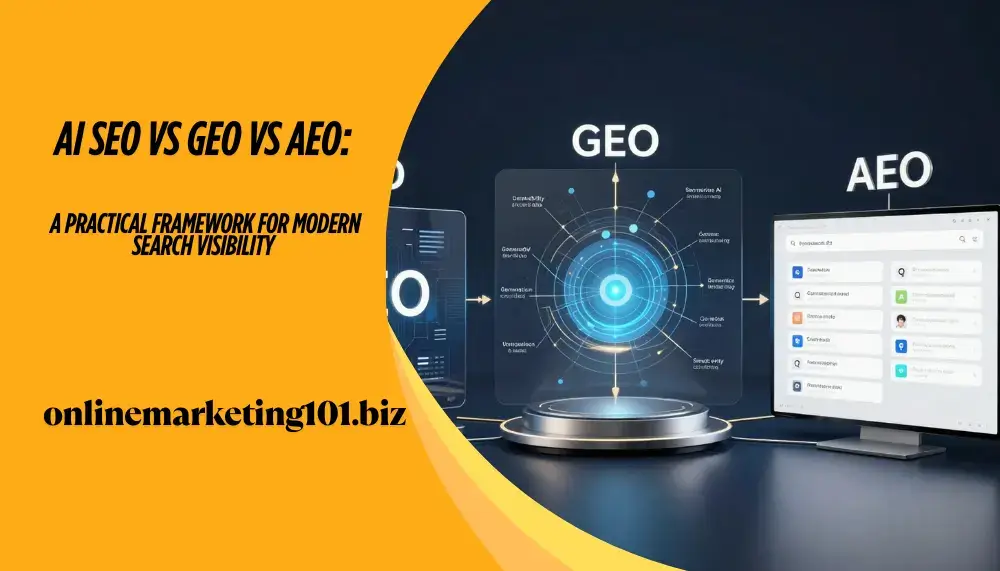
In this article, we clarify the three most important concepts — AI SEO, GEO and AEO — and then provide a practical five-step framework that a Hungarian business can use to build modern search visibility. The most important message is this: AI SEO, GEO and AEO are not methods that replace one another, but visibility layers that build on one another. An experienced SEO agency today works with all three layers at the same time.
What does AI SEO mean?
In short: AI SEO is the advanced, artificial-intelligence-tuned version of traditional search engine optimization. Its goal is to make the website easy to process, logical and context-rich not only for search crawlers, but also for AI-based interpretation systems.
It is important to understand this correctly: classic SEO has not “died.” Quite the opposite — technical SEO, content SEO, internal linking, entity building and structured data have never been more important. AI systems largely work from the same signals as search engines, but they are much more sensitive to content structure, accuracy and relationships.
The main goal of AI SEO
The goal of AI SEO is to make a website “readable” not only for search crawlers, but also for AI-based interpretation systems. In practice, this means that the content must be logical, well-structured, factually accurate and rich in context. An AI system can reliably process and use a page when it is clear who the author is, what the topic is, which entities the text discusses, and which questions it answers.
Elements of AI SEO
- Technical SEO foundations: clean site structure, error-free crawlability, organized URL structure — the same principles that form the foundation of e-commerce SEO.
- Fast loading and indexability: if Google cannot efficiently crawl the site, AI systems will also receive weaker signals.
- Structured data: schema.org markups such as Article, FAQPage, Organization and Person help AI identify exactly what is what on the page.
- Consistent use of entities: the brand name, services and experts should be named consistently across every surface.
- Expert content: real experience-based, first-hand knowledge — not repackaged generalities.
- Internal link network: internal links make the relationships between topics machine-readable.
- Updated content based on search intent: the content should answer what the user is actually asking.
AI SEO is therefore not a new trick, but a shift in mindset: the website is built so that a machine can understand it as accurately as a human can. In this work, an experienced SEO specialist can help by seeing both the technical and content sides at the same time.
What does GEO, or generative engine optimization, mean?
In short: GEO, or Generative Engine Optimization, optimizes for generative search engines and AI answer systems. The goal is for an AI system to use, mention or recommend the brand, content and expert claims as a source while generating an answer.
With GEO, the question is no longer only whether a page appears in Google’s search results. The real issue is whether, when a potential customer asks ChatGPT, Perplexity or Google AI Overviews — “which Budapest agency works with AI-powered search optimization?” — the company’s name appears in the answer. This type of AI visibility is already a direct business issue in 2026, not a technical detail.
The essence of GEO
The goal of GEO is for the business to appear as a topical expert in answers generated by artificial intelligence. To achieve this, the content must be citable, unambiguous, well contextualized and professionally credible. AI systems prefer sources that make clear claims, use data and examples, and are supported by a consistent expert entity reinforced across multiple surfaces.
How is GEO different from SEO?
SEO primarily targets the ranking logic of search engines: it is measured in positions, clicks and organic traffic. GEO, by contrast, focuses on getting the brand and the content into the AI systems’ knowledge map — the internal representation the model uses to decide whom to mention on a given topic. For GEO, the following are especially important:
- Brand mentions: the more often the brand name appears in relevant professional contexts, the stronger its association with the topic becomes.
- Expert sources: content with authors, names and credibility background.
- External credibility signals: professional publications, guest articles and industry references.
- Topic clusters: a topic is covered not by a single article, but by a connected content network.
- Answer-format content: paragraphs that an AI can lift into its answer without modification.
- PR and professional publications: digital PR and GEO are now inseparable.
- Clear author and company entities: AI knows who is speaking, on behalf of which company, and with what expertise.
GEO is therefore the intersection of classic SEO and brand building. For a modern online marketing agency, this means content production, PR and technical optimization working together in one coordinated system.
What does AEO, or answer engine optimization, mean?
In short: AEO, or Answer Engine Optimization, aims to make website content provide direct, accurate and easily citable answers to users’ questions — in featured snippets, AI answers, voice searches and question-and-answer search results.
Of the three concepts, AEO is the most “tangible.” While AI SEO is about foundations and GEO is about credibility, AEO thinks in concrete content formats: how a text should be written and structured so that it works as an answer.
The main logic of AEO
AEO does not think in long, complicated explanations, but in quickly interpretable, precise answers. A well-optimized AEO content asset can provide a short, clear and source-ready answer to a specific question — typically in the first one or two sentences of the section. Details, nuance and examples follow afterward, but the essence comes first. This is exactly the structure that answer engines and voice assistants prefer.
AEO content formats
- FAQ blocks: concise answers to real user questions, ideally supported with structured data.
- Definition paragraphs: self-contained explanations in the format “X means that…”.
- “What is,” “how does it work,” and “when is it worth it” sections: the question itself is the subheading, with the answer directly below.
- Tables: comparisons, parameters and price categories in a machine-readable format.
- Step-by-step guides: numbered, logical process descriptions.
- Short summaries: concise takeaways placed at the beginning or end of sections.
- Structured data: FAQPage, HowTo and similar schema markups that make the format machine-readable.
AEO fits especially well into a thoughtful search marketing strategy: the same content that appears as a featured snippet in Google has a higher chance of appearing as a source in AI answers. We wrote in detail about how this works in practice in our article on the work of a search marketing agency.
AI SEO vs GEO vs AEO – what is the difference in short?
The easiest way to understand the difference between the three approaches is through a single table. Notice that these are not competing methods, but three mutually reinforcing levels of the same visibility system.
| Area | Main goal | What does it optimize for? | Typical tools |
|---|---|---|---|
| AI SEO | Better organic and AI interpretability | Google, search crawlers, AI-powered search systems | technical SEO, content structure, schema, internal links |
| GEO | Appearance in generative AI answers | ChatGPT, Perplexity, Google AI Overviews-type answers | entity building, PR, expert content, credibility signals |
| AEO | Direct answers to questions | answer engines, featured snippets, voice search | FAQs, definitions, question-and-answer blocks, short explanations |
The most important difference
If we had to summarize it in two sentences: SEO helps you get found. GEO helps AI systems understand and recommend you. AEO helps your content appear as a direct answer. A company that aligns all three covers the full spectrum of search visibility — while a company that focuses on only one gives the other two fields to competitors.
Practical framework: how to build modern search visibility?
Theory alone is not enough. The following five-step Roth Creative framework shows the order and logic in which modern search visibility should be built — regardless of whether the company is a service provider, an online store or an expert brand.
Fixing the technical foundations
Before we talk about AI visibility, the website must be technically stable. It should be fast, mobile-friendly, indexable and well structured. If Google cannot properly crawl the site, it also sends weaker signals to AI systems — even the most careful content strategy gets lost when the foundations are flawed. A technical audit of search engine optimization is therefore always the first step.
Building topic clusters and entities
In modern search, it is no longer enough to optimize for individual keywords — topics must be built. A business must clearly show which topics it is an expert in, what services it provides, which problems it answers, and in what market context it operates. The logic of topic clusters is simple: detailed articles are organized around a central pillar content asset and connected through consistent internal linking.
Creating answer-oriented content
For every important service and problem, it is worth creating question-based content. For example: What is AI SEO? How is GEO different from traditional SEO? How can a Hungarian company appear in AI answers? Why is AEO important in 2026? These questions are not only subheadings — they are exactly the formulations users ask AI systems as well.
Strengthening credibility signals
One of the keys to GEO and AI visibility is credibility. The brand must appear consistently in professional articles, PR materials, case studies, author profiles and industry contexts. AI systems treat entities reinforced by multiple independent sources as trustworthy — exactly as an experienced SEO agency in Budapest builds client authority through external credibility signals.
Continuous measurement and updating
Modern search visibility is not a one-time project, but an ongoing process. Keyword positions, organic traffic, AI mentions, branded searches, conversions and content coverage must all be measured. What performs well today must be refreshed six months from now — AI systems learn quickly, and competitors are not sleeping either.
Which types of companies especially need AI SEO, GEO and AEO?
Modern search visibility is important in principle for every business, but there are company types where the stakes are especially high. Typically, these are businesses where the buying decision is based on trust, expertise or complex evaluation — in other words, where the potential customer asks many questions before choosing.
- Service companies where a longer research process takes place before the decision.
- Consultants and expert brands for whom personal credibility is the most important asset.
- Healthcare and legal service providers where accuracy and trustworthiness are fundamental requirements.
- Online stores — we also wrote a dedicated guide on e-commerce SEO.
- B2B companies where decision-makers increasingly use AI tools to research suppliers.
- Local Budapest companies where “best X in Budapest” type AI questions can generate direct demand.
- Premium service providers where perceived expertise is the foundation of pricing.
- Education, technology and creative businesses where a thought-leader position is a sales advantage in itself.
The main message: the more complex, trust-based or expert-driven a service is, the more important it becomes for AI systems to accurately understand the role of the business. This should already be considered at the foundations of online presence — for example during online store development: a well-structured website with clear entities is the foundation of later AI visibility.
Common mistakes when introducing AI SEO, GEO and AEO
The good news is that the most common mistakes are easy to identify — and all of them can be fixed. Let’s look at the four most typical ones.
1. Thinking only in keywords
Keywords are still important, but on their own they are not enough. Modern search interprets topics, relationships, entities and intent. A piece of content performs well when it does not merely contain the keyword, but truly covers the question behind it — together with context, examples and related concepts.
2. No clear expert positioning
If a company does not clearly explain what it is an expert in, whom it helps and what problem it solves, AI systems will also find it harder to connect the company to the right topics. The vague message of “we are good at everything” means invisibility in the age of generative search.
3. Missing answer structure
Long articles are not enough on their own. Content must be structured with short answers, definitions, lists, tables and FAQ elements. The same knowledge has a much higher chance of appearing as a featured result or AI answer when it is presented in an answer structure.
4. No regular updates
AI visibility is a dynamic field. Content, internal links, schema data and professional references must be updated continuously. A page reflecting the state of 2024 is no longer a competitive source in 2026 — neither for Google nor for AI systems.
How can Roth Creative help build modern search visibility?
Roth Creative works with an SEO and online marketing mindset that connects classic search engine optimization with the new requirements of AI visibility, GEO and AEO. The goal is not only for a website to achieve better rankings, but also for the brand to become understandable, credible and recommendable in the modern search environment over the long term.
In practice, this means thinking in one coordinated system, from technical audits through topic cluster planning and answer-oriented content production to credibility building. The strategic background is provided by the experience of Róth Miklós, SEO specialist, while execution is handled by a team that works daily with both classic SEO and the requirements of the AI era. If you want to understand more deeply why AI visibility has become a strategic issue for Budapest companies, read our analysis on AI visibility for Budapest companies, or explore our online marketing agency Budapest services.
Summary – the search strategy of the future has three layers
Modern search visibility does not depend on a single technique. AI SEO provides the foundations: a technically stable, well-structured website with clear entities. GEO helps the brand enter the world of generative answers: through credibility, brand mentions and expert positioning. AEO turns expert content into direct answers: with definitions, FAQ blocks and answer-oriented structure.
Companies that today think only in classic SEO terms may soon fall into a visibility disadvantage. But those that align AI SEO, GEO and AEO can build a stronger brand presence not only in Google, but also across AI-powered search environments — and this difference will become a larger business advantage year after year.
Are you ready for the new era of search?
If you want your business to appear more strongly not only in search engines, but also in AI answers, it is worth thinking in terms of a modern SEO and AI visibility strategy. Roth Creative helps prepare your website technically, content-wise and strategically for the new era of search.
Related SEO and online marketing services on the Roth Creative website →
Frequently Asked Questions
What is AI SEO?
AI SEO is a modern approach to search engine optimization that optimizes a website not only for traditional search engines, but also for AI-based interpretation and answer systems. Its foundation is technical stability, structured data, consistent entity usage and expert content.
What does GEO mean?
GEO, or generative engine optimization, aims to make a brand, expert or website appear in the answers and recommendations of generative AI systems such as ChatGPT, Perplexity or Google AI Overviews.
What is AEO?
AEO, or answer engine optimization, aims to make website content provide direct, accurate and easily citable answers to users’ questions — in the form of FAQ blocks, definitions, tables and step-by-step guides.
Which is more important: SEO, GEO or AEO?
It is not worth choosing between them. The strongest strategy emerges when technical SEO, GEO-based credibility building and AEO-based answer structure work together — as three visibility layers that build on one another.
Why is this important for Hungarian companies?
Because buyers, decision-makers and clients increasingly use AI systems to search for answers, service providers and experts. Companies that do not appear in these answers may gradually fall behind competitors in visibility.